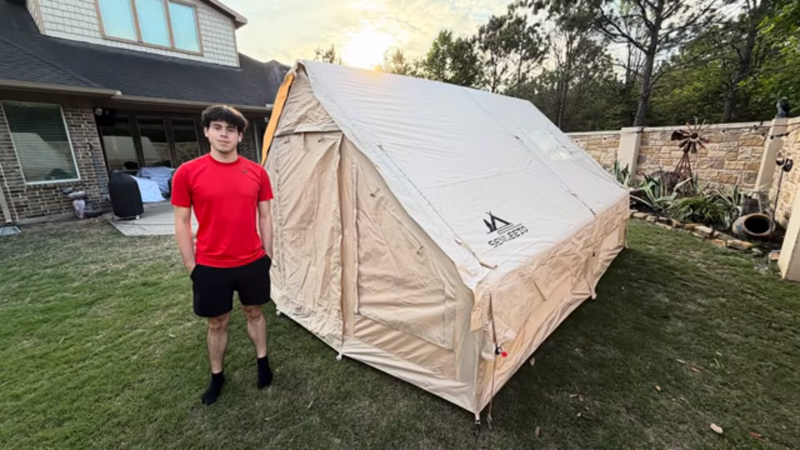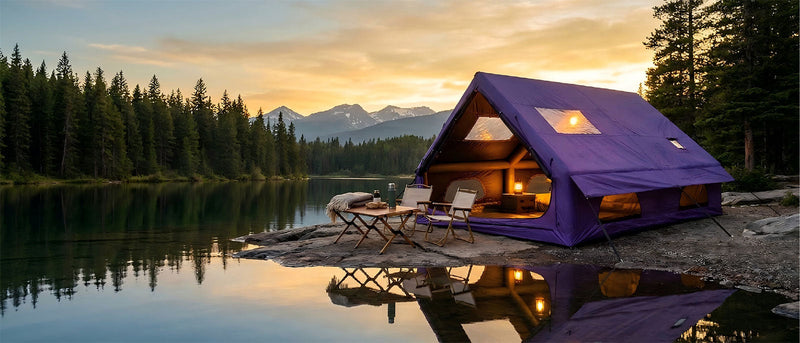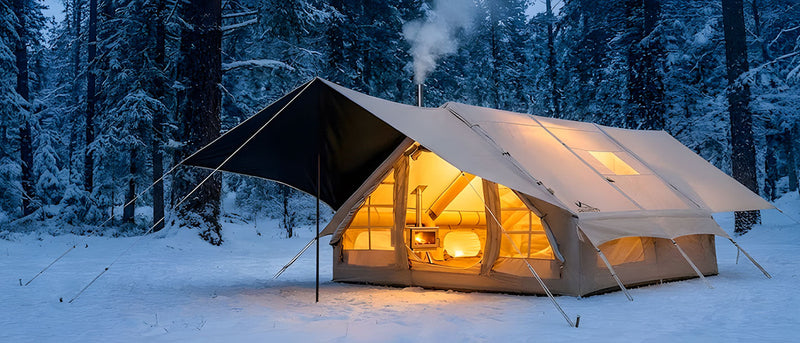

First time with an inflatable tent? This guide walks you through everything — from unboxing to fully standing — including how to attach the awning and use the rainfly. Real setup photos throughout.
Here's the mistake almost every first-timer makes: they start pumping before staking the tent down. Five minutes later, the air beams are twisted, the tent looks wrong, and they're starting over.
It's an easy fix — and once you know the right order, setting up this tent is genuinely one of the easiest things you'll do at a campsite. Here's exactly how to do it.
What You'll Need

Everything in the box — tent body, air beam frame, support poles, stakes, guy ropes, manual pump, and repair kit.
- Tent body (pre-attached to the waterproof groundsheet)
- Air beam frame — inflates to form the roof structure
- Support poles (6 uprights — assemble before inserting)
- Awning canopy (attaches via zipper for shade or rain cover)
- Ground stakes (included)
- Guy ropes (included)
- Manual pump (included) — or use an electric pump for faster setup
- Repair kit (included)
No complicated pole system to figure out. The uprights click together in sections and drop into their sleeves — it's straightforward once you've seen the parts laid out.
Step-by-Step Setup Guide
Pick Your Spot and Lay the Groundsheet Flat
Clear the area of sharp rocks or sticks. Unfold the tent and lay the groundsheet flat, positioning the door in the direction you want it to face.
Take 30 seconds to get the orientation right now — it's much harder to rotate once the tent is standing.
Stake Down All Four Corners First
This is the step most people skip — and it's the most important one.
Before you touch the pump, find the four corner loops and drive a ground stake through each one. The stakes keep the tent anchored so the air beams rise straight up during inflation. Without them, the beams twist as they fill and your tent ends up lopsided.
Don't skip this step.
Assemble and Insert the Support Poles
Connect the pole sections for each of the 6 uprights, then insert them into their designated sleeves at the tent corners and mid-points. They slot in from the bottom and rest in the base cups on the groundsheet.
The poles don't need to be locked under tension at this stage — they just need to be in position before inflation begins.
Connect the Pump and Inflate
Locate the air valve on the side of the tent near the base. Connect your pump nozzle and start pumping.
With the included manual pump: expect around 200–230 presses for a full inflate — about 5–7 minutes. An electric pump cuts this to 2–3 minutes.
Watch the air beams as they rise. They should lift the roof structure evenly and straight up.

Check the Shape and Top Up if Needed
Once fully inflated, walk around the tent. The roof structure should be firm and taut, not soft or wrinkled. Add a few more pumps to any section that looks slightly underinflated.
Don't overinflate — the beams are designed to flex slightly. If they feel rock-hard and you hear creaking, release a little air.
Adjust the Door Panels and Screens
Open or roll back the door panels to your preference. The tent has three configurations: fully open (panels rolled up, screens open for maximum airflow), screens only (keeps insects out while staying ventilated), or fully closed (all panels down for privacy or weather).
Secure the Guy Ropes
Attach the guy ropes to the loops on the tent body and stake them out at an angle. Optional in calm weather — essential if there's any wind. A properly guyed tent is dramatically more stable in gusts.
Total time from unboxing to done: under 15 minutes on your first attempt. Under 10 once you've done it once.
How to Attach the Awning
The awning is one of this tent's standout features — it extends your covered outdoor space significantly and can also double as a rainfly draped over the roof. Here's how to use both modes.
- Locate the zipper strip running along the front roofline of the tent. This is where the awning attaches.
- Zip the awning onto the tent — start from one end and work across. The zipper runs the full width.
- Insert the two awning poles into the pockets at the outer corners of the awning canopy.
- Stake out the awning poles at a slight outward angle and run the guy ropes to keep them steady.
-
Adjust the canopy angle by lengthening or shortening the pole inserts until the awning sits level.

Front view with awning fully deployed — adds significant covered outdoor space for cooking or relaxing.

The same awning draped over the roof as a rainfly — no extra accessories needed.
Electric Pump vs Manual Pump: Which Should You Use?
Both work. Here's when each makes sense:
Good for remote camping where there's no power source. The included pump is lightweight and takes 5–7 minutes. Fine for occasional camping.
Ideal if you have a portable power station or car outlet nearby. Cuts setup time to 2–3 minutes. Worth the small extra cost if you camp regularly.
Common Mistakes to Avoid
- Not staking first — the single most common error. Always stake all four corners before pumping.
- Skipping the support poles — the uprights need to be in their sleeves before inflation so the structure rises correctly.
- Overinflating — firm is good, rock-hard is too much. The beams need a little flex to handle wind loads.
- Skipping the guy ropes — even a moderate breeze can shift an unsecured tent. Always stake out the ropes if conditions are uncertain.
- Setting up on uneven ground — a slight slope is fine, but large bumps will make the floor uncomfortable and stress the base material.
- Packing away wet — if you roll the tent up damp, mold can develop inside the fabric. Air it out before packing whenever possible.
Frequently Asked Questions
Can I set it up alone?
Yes. Every step in this guide is single-person friendly. You don't need a second person at any stage — staking, pole assembly, pumping, and attaching the awning are all manageable solo.
What happens if the tent gets a puncture?
The tent uses independent air chambers, so a puncture in one beam doesn't collapse the whole structure. The tent will lean slightly but remain standing. Every tent ships with a repair kit — patches are straightforward to apply and hold reliably.
Can I use it in the rain?
Yes. The roof and base use 500–600D Oxford fabric with good water resistance. For heavy or sustained rain, deploy the awning as a rainfly over the roof (draped flat, not propped up) and make sure the guy ropes are fully staked out.
How do I take it down?
Open the air valves to deflate, fold the tent flat, and roll it toward the valves to push remaining air out. Remove the support poles before rolling. It packs down to a surprisingly compact size for a tent this large.
What size group is this tent for?
The standard configuration sleeps 4–6 people comfortably. With the awning extended as a covered living area, there's plenty of room for a family to cook, eat, and relax without going inside.
When does it arrive in the US?
This model is currently in transit to our US warehouse and will be available for shipping in approximately 6–7 weeks. You can join the waitlist on the product page to be notified when it's in stock.


Ready to Set One Up Yourself?
The setup process is one of the biggest reasons people switch to inflatable tents and never go back. Once you've done it once, wrestling with poles feels like a step backward.
This model arrives in our US warehouse in approximately 6–7 weeks.
👉 Join the Waitlist — Browse the Collection